
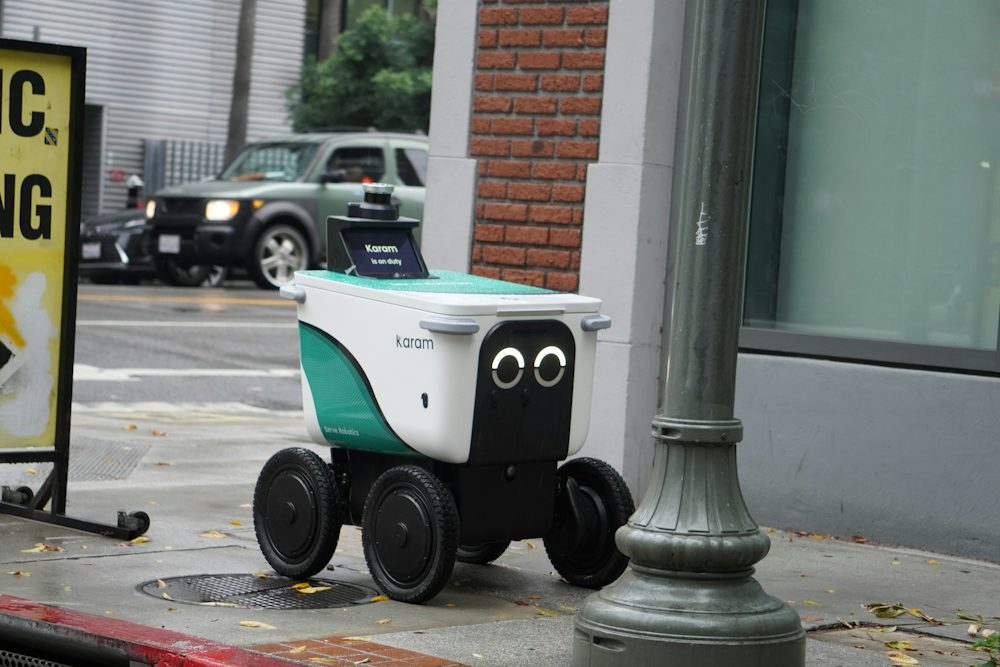
Why does a package from a factory on the other side of the world cost a dollar to ship, while a sandwich from the shop two blocks away costs ten dollars to deliver? That is the question Serve Robotics co-founder and CEO Ali Kashani has been asking publicly, and on November 11, 2026, his company tried to do something about it. Serve opened its fleet of 2,000 sidewalk delivery robots to anyone who can write a little code, not just the handful of big delivery apps that have controlled access until now.
The new AV Delivery Developer Portal is confirmed and live: Serve’s own announcement, posted through GlobeNewswire, lays out a public API and a free sandbox at developer.serverobotics.com. What is not yet settled is how many outside businesses will actually get to use it, since every real-world robot dispatch still needs Serve’s sign-off first.
What You Can Now Do With Serve’s Robots
Until this month, the only way to get one of Serve’s googly-eyed robots moving was to order through a partner platform like Uber Eats, Grubhub or DoorDash. The new portal changes that. A business, an independent developer, or even an AI assistant can now send a pickup and drop-off address straight to Serve’s system, get back a price and an estimated arrival time, and track the robot until the delivery is marked complete.
Serve handles the parts a small business could never build on its own: routing the robot, steering it around obstacles, and keeping a remote supervisor watching over the trip. A sandbox environment lets a developer run through the whole process with a simulated robot first, including testing what happens when a request gets rejected, before anything real rolls out the door.
Serve’s own announcement points to uses well beyond food:
- A pharmacy or florist adding robot delivery straight to its own checkout page, instead of paying a delivery app’s cut
- A business shuttling documents or supplies between two of its own offices
- A repair shop sending a part across town without a dedicated driver
- Someone sending a neighbor an item they sold online, without either person leaving home
Why Local Shops Have Been Shut Out Until Now
The reason this matters to a corner store comes down to math. Delivery platforms typically keep between 15 and 30 percent of every order, according to a Martin Cid Magazine report on the launch, largely to cover the cost of a human courier’s time. A small shop with thin margins can struggle to absorb that, or has to pass it straight to the customer.
Kashani’s pitch is that a robot changes that math. He told interviewers that a merchant paying per delivery or reserving robot time by the hour would pay only a fraction
of what a human courier costs, according to Martin Cid Magazine. Kashani has also pointed to the quiet hours between lunch and dinner, when restaurant orders dry up but the robots sit idle, as exactly when outside demand could put the fleet to better use.
The timing lines up with a bigger shift at Serve. Serve said in August it would not renew its agreement with Uber Eats, its original and best-known partner, and has since leaned harder on deals with Grubhub and new cities like Washington, DC and San Jose. Opening the fleet to anyone willing to build on the API is Serve’s next move away from depending on any single delivery app.
Where the Catch Is
None of this is a free-for-all. Reading the documentation and testing in the sandbox takes no approval, but dispatching an actual robot onto a real sidewalk does: Serve’s staff screen every new deployment by hand before it goes live, and the company has not said how long that review takes or how many outside partners it plans to accept at first.
A few other limits are worth knowing before picturing this as a universal delivery option:
- No published price list. Serve has not said what a delivery through the API actually costs; “a fraction” of a human courier is as specific as the company has gotten publicly.
- Liability is case by case. Kashani has said who pays for a lost or damaged item depends on how each partnership is priced and insured, not a single company-wide policy.
- US cities only, for now. The fleet operates in more than 150 neighborhoods across 20 US cities, including Los Angeles, Miami and Dallas. Serve also runs robots in Australia, but has not said whether those are part of the new portal, and there is no timeline for Europe, Asia or Latin America. Other companies are moving more cautiously with sidewalk robots: Hoboken, New Jersey, capped its own delivery-robot pilot at 12 months before deciding whether to let it continue.
- Sidewalk speed only. The robots top out around 6 miles per hour, and Serve has said it has no plans to put them on the road, so this suits short neighborhood hops, not cross-town trips.
Every delivery dispatched through the API still runs under the same rules as Serve’s existing service: it has to start and end inside an active service area and operating window, the item has to fit in the robot’s cargo compartment, and a remote human supervisor is still watching the trip.
Why It Matters to You
If you own or work at a small shop in one of Serve’s 150-plus neighborhoods, this is a real, if gated, new option: you could add robot delivery to your own website or app without handing a chunk of every sale to a delivery platform, once Serve approves your request. A developer or small software business can start today: the sandbox is free to experiment with right now, even though live robots are not guaranteed yet. Outside Serve’s current cities, or outside the US entirely, none of this reaches you yet, and Serve has not said when, or if, that will change.
The honest version is that most people will not notice anything different this week. What is different is who gets to decide a robot should move: not just a handful of app companies, but potentially any shop, developer, or AI assistant with an approved use case.
Serve’s robots have already completed hundreds of thousands of deliveries and reach a combined population of roughly 3 million people across their current coverage area, according to the company. The question now is whether opening the gate to outside builders turns that into something a lot more people actually use, or stays a developer curiosity that the biggest delivery apps never felt pressure to match.
Sources
- Serve Robotics (via GlobeNewswire): Serve Robotics Opens Its Robot Delivery Network for Anyone to Build On (Nov. 11, 2026)
- Martin Cid Magazine: Serve Robotics lets shops and AI agents summon its 2,000 sidewalk robots (Nov. 12, 2026)