
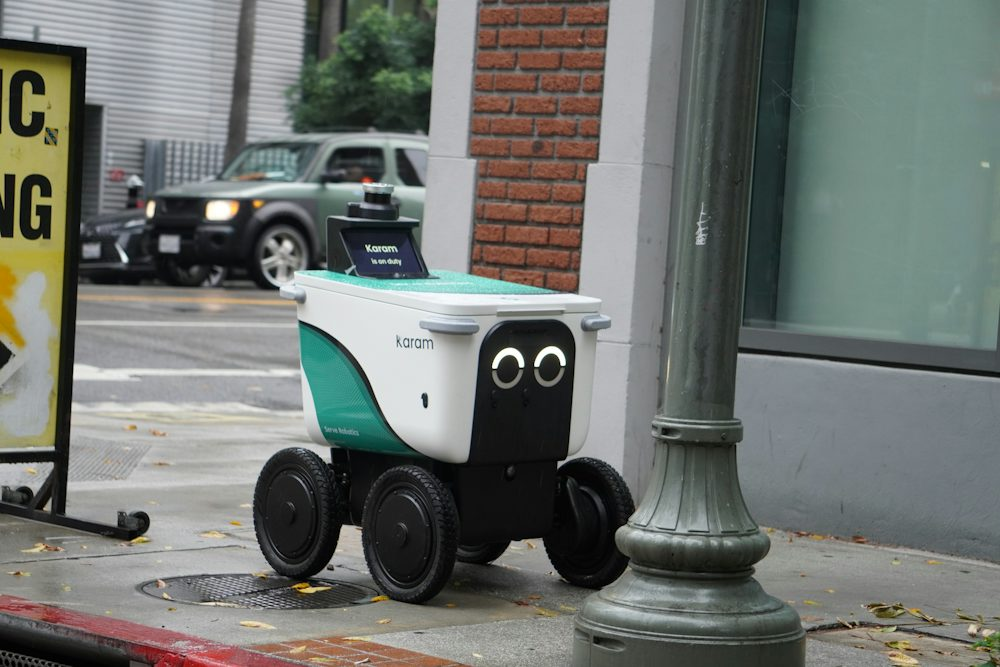
Order a sandwich in parts of Center City Philadelphia today, and it might arrive on six wheels instead of in a car. Avride’s cooler-sized sidewalk robots have been delivering Uber Eats orders in Center City, Chinatown, and Old City since March 2026, and on November 10, 2026, the company said its robots have now completed one million deliveries across more than 30 U.S. markets, Philadelphia among them. The city is also where the service has run into its toughest local pushback.
Here is what the robots actually do on Philadelphia sidewalks, how the company got to a million deliveries nationally, and why a city councilmember wants to charge Avride for every single trip.
How Avride’s Robots Work on Philadelphia Sidewalks
- Legal status: Pennsylvania’s vehicle code treats “personal delivery devices” like Avride’s robots as pedestrians. They generally have to follow pedestrian rules, yield to people walking and cyclists, and cannot assume they have the right of way on a sidewalk.
- Speed: The robots move at up to about 5 mph, roughly a brisk walking pace.
- Cost to order: Uber Eats says there is no added fee or tip for robot delivery. Grubhub, which recently started offering Avride robots too, has not said whether its pricing will match.
- Where they run: The original rollout covers Center City, Chinatown, and Old City, with deliveries generally no more than 2 miles. Roughly a dozen robots are on the street at any given time, and Avride says the fleet will grow “alongside the needs of the program.”
- Oversight: A remote human supervisor can take over if a robot gets stuck or confused.
From a Center City Pilot to a Million Deliveries: A Quick Timeline
- March 2026: Uber Eats and Avride launch sidewalk robot delivery in Center City Philadelphia.
- May 2026: Avride reports roughly 600,000 total deliveries and about 500 robots on the road nationally, a figure tied to its expansion into Arlington County, Virginia.
- October 2026: The company says it completed about 180,000 deliveries in that month alone, a pace of roughly 7,000 a day.
- November 10, 2026: Avride announces it has passed one million total deliveries, spread across more than 30 U.S. markets.
Every one of those numbers comes from Avride itself. No independent audit of the company’s delivery count has been published, and Avride has not broken the million-delivery figure down by city, so there is no way to say from public sources how many of those trips happened in Philadelphia specifically.
Robot Delivery vs. the Alternatives
| Option | Typical Cost | Speed | Best For |
|---|---|---|---|
| Avride sidewalk robot (Uber Eats) | No added fee or tip, per Uber Eats | Up to about 5 mph | Short trips within about 2 miles in Center City, Chinatown, or Old City |
| Delivery app with a human courier | Delivery fee plus optional tip | Varies with traffic | Longer distances, bad weather, heavier orders |
| Walking or driving yourself | No delivery fee | Depends on distance and parking | People who have the time and mobility to go themselves |
For someone without a car, without time to walk, or who just wants food to show up without tying up a human driver, the robot is one more option on the list, not a replacement for the others.
Why Some Philadelphians Want the Robots Gone
Not everyone in the city has welcomed the robots. In late March 2026, someone kicked one over near Juniper and Locust streets. In April 2026, a pedestrian said a robot bumped into her from behind at 15th and Locust streets, leaving a scratch. Robots have also been vandalized, graffitied, and deliberately blocked by people walking by.
The most visible protest came on October 14, 2026, when Carolyn Marvin, a 78-year-old retired University of Pennsylvania communications professor, stood in front of a delivery robot on Filbert Street near Reading Terminal Market and refused to move. Police arrived, and she was arrested and issued a disorderly conduct citation. Marvin told reporters she believes companies are using the robots to replace human delivery workers, said she has blocked robots for months as a form of protest, and plans to contest the citation in court on First Amendment grounds.
City Councilmember Jeffery Young Jr. introduced a bill in May 2026 that would require delivery companies to register their robots with the city, file regular reports, and pay a $1,000 fee for every delivery an autonomous unit completes on a sidewalk. That fee would be far more than the food itself typically costs. The bill is still sitting in committee and has not become law, so the robots keep operating under Pennsylvania’s existing pedestrian classification for now.
Why It Matters to You
- If you order Uber Eats in Center City, Chinatown, or Old City, a robot might already bring your food, at no extra cost compared to a human courier.
- The service is still small and local, not citywide, so whether you see a robot depends heavily on your address.
- Whether the city council bill passes could decide if Avride keeps operating here at all, so this setup is not guaranteed to last in its current form.
- Nationally, the million-delivery milestone shows sidewalk robots have moved past small pilots into routine, daily use in dozens of cities, even as some of those same cities are still writing the rules for them.
Sources
- Robotics & Automation News, “Avride Reaches One Million Robot Deliveries as Network Expands Across US,” November 15, 2026
- PhillyVoice, Molly McVety, Uber Eats delivery robots launch in Philadelphia, March 10, 2026
- Billy Penn (WHYY), Davis Cuffe, “Philly Keeps Fighting Its Delivery Robots. More Are Coming Anyway,” October 21, 2026
- Fox News, Pennsylvania delivery robot law and protester arrest, October 2026
- Food on Demand, Avride’s Arlington County, Virginia expansion, June 17, 2026