
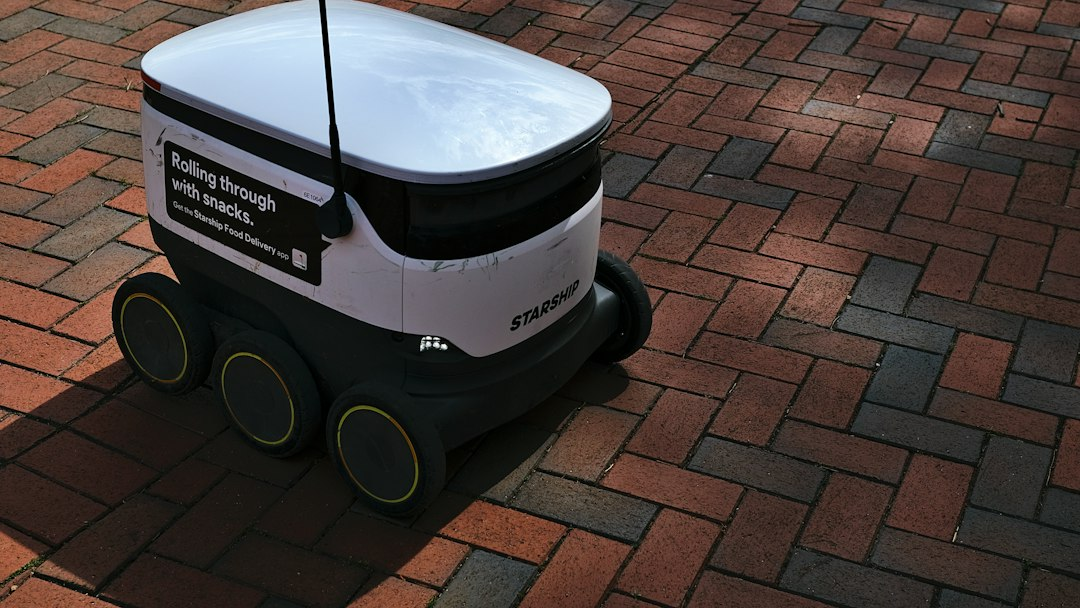
Desta crosses a dark, windy quad in her wheelchair at nine o’clock on a Tuesday, already behind on a problem set. Dinner sits twenty minutes away, round trip, on the far side of campus. Tonight she skips the walk. She orders from the dining hall on an app, and twelve minutes later a small robot parks outside her building with her food tucked inside. Campus delivery robots like this one are about to show up on a lot more campuses.
Avride, the autonomous delivery company, and Sodexo Campus announced on October 7 that they’re scaling robot food delivery across Sodexo’s network of roughly 425 U.S. colleges and universities, according to Robotics & Automation News. Four schools already run the service: Ohio State University, Indiana University Bloomington, the University of Arizona, and Salisbury University. Every other campus in that network can now sign up and go live in weeks instead of months.
She Didn’t Have to Choose Between Dinner and a Deadline
Picture who actually feels this change. A resident assistant working the overnight desk who can’t leave her post to grab food. A commuter student juggling two part-time jobs with forty-five minutes between class and work. A student managing a chronic illness who can’t make three round trips across a 1,200-acre campus in freezing rain. None of them need a car, a rideshare app, or a body that can sprint across campus before the dining hall closes.
I’ve watched this kind of technology move from novelty to normal over the last few years, and the pattern keeps repeating. The first reaction is always “that’s cute.” The second reaction, once someone actually needs it at eleven at night in the rain, is closer to relief.
What Campus Delivery Robots Actually Save You
The math is modest per order, but it adds up fast. Third-party apps like Uber Eats and DoorDash typically charge $5 to $8 in fees on top of the food and tack on a 20-to-40-minute wait. A robot running on sidewalks the school already owns tends to cost closer to a few dollars a trip. Order twice a week for a semester, and that gap alone can save a student over $150, on top of the 15 to 20 minutes they’re not spending walking there and back in the cold.
Not every student is sold on the fee. At Salisbury University, student Jordan Webster told WMDT the robots felt “a little bit of a scam” when a three-minute walk would do the same job. Fair point, if you’re healthy, free at 6 p.m., and the sidewalk isn’t a sheet of ice. Classmate Luke Thurston saw it differently: “It’s so convenient.”
“Our robots have already proven their value in campus environments,” said Dmitry Polishchuk, Avride’s CEO.
From One Ohio Campus to 425 Nationwide
Avride’s robots have logged more than 600,000 deliveries across campuses and cities, in rain, snow, and sidewalks packed with students between classes. That track record is what let Sodexo move from a handful of pilots to a network-wide rollout. Ohio’s embrace of driverless technology isn’t limited to sidewalks, either. The state is also running driverless electric freight trucks on its highways, and public comfort with the whole category keeps climbing, according to recent survey data on robotaxi trust.
If your campus dining service hasn’t announced a robot fleet yet, ask when it’s coming. Four schools are live. 421 more are eligible. That gap is only going to close faster from here.