
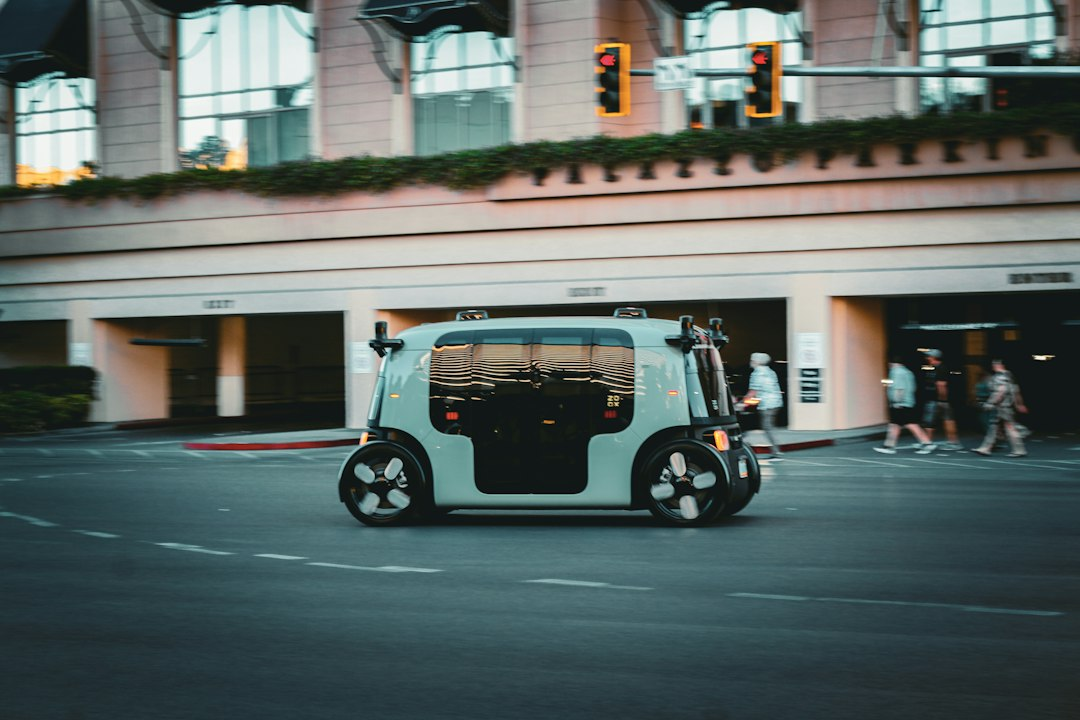
How do you know, glancing at a car stopped at a red light, whether anyone is actually driving it? Federal regulators think they have an answer: cyan lights on driverless cars.
On October 26, 2026, the National Highway Traffic Safety Administration filed a notice of proposed rulemaking in the Federal Register. It would let automakers add optional blue-green marker lights to vehicles built without a steering wheel or pedals, the kind of car nobody inside can actually drive. The agency opened a 30-day public comment period under docket NHTSA-2026-1519, running to roughly November 25, 2026. Nothing is final. This is a proposal, not a new law, and NHTSA could change or drop parts of it after reading what comes in.
What the Proposed Lights Would Actually Look Like
The rule amends Federal Motor Vehicle Safety Standard No. 108, the decades-old regulation covering car lamps. Automakers would not be required to add anything. If they choose to, though, the lights have to follow a specific recipe:
- Placement: One or two lamps each at the front, sides, and rear, for a total of four to eight.
- Height: Mounted at least 15 inches off the ground, visible from any angle around the car.
- Behavior: Steady-burning, not flashing, though NHTSA says it’s open to allowing a flashing option later.
- Color: A specific blue-green shade called cyan, picked in part so nobody mistakes it for a police officer’s blue lights.
- Timing: Lit only while the automated driving system is in charge and no one inside is expected to watch the road.
The proposal also strips out some rules written for human drivers that make no sense in a car without one, like the requirement that turn signals cancel themselves. NHTSA’s reasoning is almost deadpan: software “cannot forget that the turn signals are active.” A driverless car does not need a trick to remind it to stop signaling.
Why Regulators Want Cyan Lights on Driverless Cars
The pitch is simple. Cyan lights give everyone outside the car, not just engineers, a one-glance answer: is a person actually watching the road, or not? Mercedes-Benz first pitched the idea to NHTSA for its Level 3 Drive Pilot system. It tested 360-degree cyan lighting on vehicles in California from 2023 through 2025, and California already allows it. NHTSA’s new proposal would take a version of that state standard national. It would likely preempt California’s own rules where the two differ.
Police officers and paramedics get a direct, practical use out of this. Right now, an officer walking up to a stopped car with an empty driver’s seat has to figure out fast whether that’s a car with nobody driving it on purpose, or a car whose driver is missing, hurt, or fled the scene. A standardized light removes the guesswork. NHTSA isn’t alone in thinking that way, either. China has proposed its own optional marker-light standard, using turquoise, set to take effect by 2028. If both countries land on a similar blue-green signal, it starts to look less like one company’s idea and more like an emerging international convention, the same way a flashing red light means stop almost everywhere already.
We’ve already seen NHTSA push for a shared, measurable standard on the self-driving side of this technology. This is the same instinct applied to something a lot more basic: what the car looks like from the sidewalk.
Why It Matters to You
- If you walk, bike, or drive near a growing robotaxi fleet, a cyan light is meant to tell you, at a glance, that nobody behind that windshield is watching the road the way a human driver normally would.
- If you ever need police or paramedics to reach a stalled car, a standard light could help first responders sort an intentionally empty seat from an emergency in seconds, not minutes.
- None of this exists on the road yet. It’s a brand-new proposal with a 30-day comment window, the lights would be optional even if finalized, and no company would have to add them.
That last point is worth sitting with. A rule like this does not reduce a single crash on its own. What it offers is clarity, the kind that lets a pedestrian, a cyclist, or a cop make a faster, better-informed call about a car they’ve never seen before.
The Cybercab Question Nobody at NHTSA Will Name
NHTSA’s proposal never mentions Tesla by name. It doesn’t have to. The only production vehicle on the road right now that fits the rule’s description, no steering wheel, no pedals, is Tesla’s Cybercab, which has been quietly growing its Austin fleet this year. Tesla has said the Cybercab already meets federal standards without needing an exemption, a claim NHTSA is currently auditing. The agency gave Tesla until October 30, 2026, to provide sworn answers about how the vehicle was certified.
People covering the industry noticed the timing. Electrek’s Jameson Dow called the lighting proposal overdue and credited career NHTSA staff for pushing it. He also questioned, in the same piece, whether a deregulatory rule like this is landing now partly because of pressure tied to the Cybercab review. Both things can be true. The specs closely match a Cybercab, but the idea itself predates Tesla’s push. Mercedes-Benz brought a version of it to NHTSA years earlier, for a car that still has a steering wheel.
What We Don’t Know Yet
- This is a proposed rule. NHTSA can revise or withdraw pieces of it once the comment period closes around November 25, 2026.
- The lights stay optional even in the version proposed now. A company could skip them entirely and still comply.
- NHTSA hasn’t published a cost or safety benefit estimate. It calls the rule deregulatory and expects no added cost, but gives no dollar figure.
- No independent study measures whether cyan lights actually cut driver or pedestrian confusion, or crashes, in real traffic. The safety case so far is reasoning, not data.
- Whether states with their own non-standard AV lighting rules get preempted is, in NHTSA’s own words, a tentative conclusion, not a settled one.
If you ever stand at a crosswalk and watch a car roll up with an empty driver’s seat, would a blue-green glow actually change how you cross the street, or would you wait for the car to stop moving either way?
Sources
- NHTSA: Notice of Proposed Rulemaking, FMVSS No. 108 (Federal Register, public inspection copy) (Oct 26, 2026)
- Tesla North: NHTSA Wants Up to 8 Cyan Lights on Robotaxis Like Tesla’s Cybercab (Oct 23, 2026)
- EV Wire: NHTSA FMVSS 108 driverless vehicles cyan ADS marker lamps (accessed Oct 27, 2026)
- Electrek: NHTSA’s proposed cyan lights for autonomous vehicles (accessed Oct 27, 2026)