
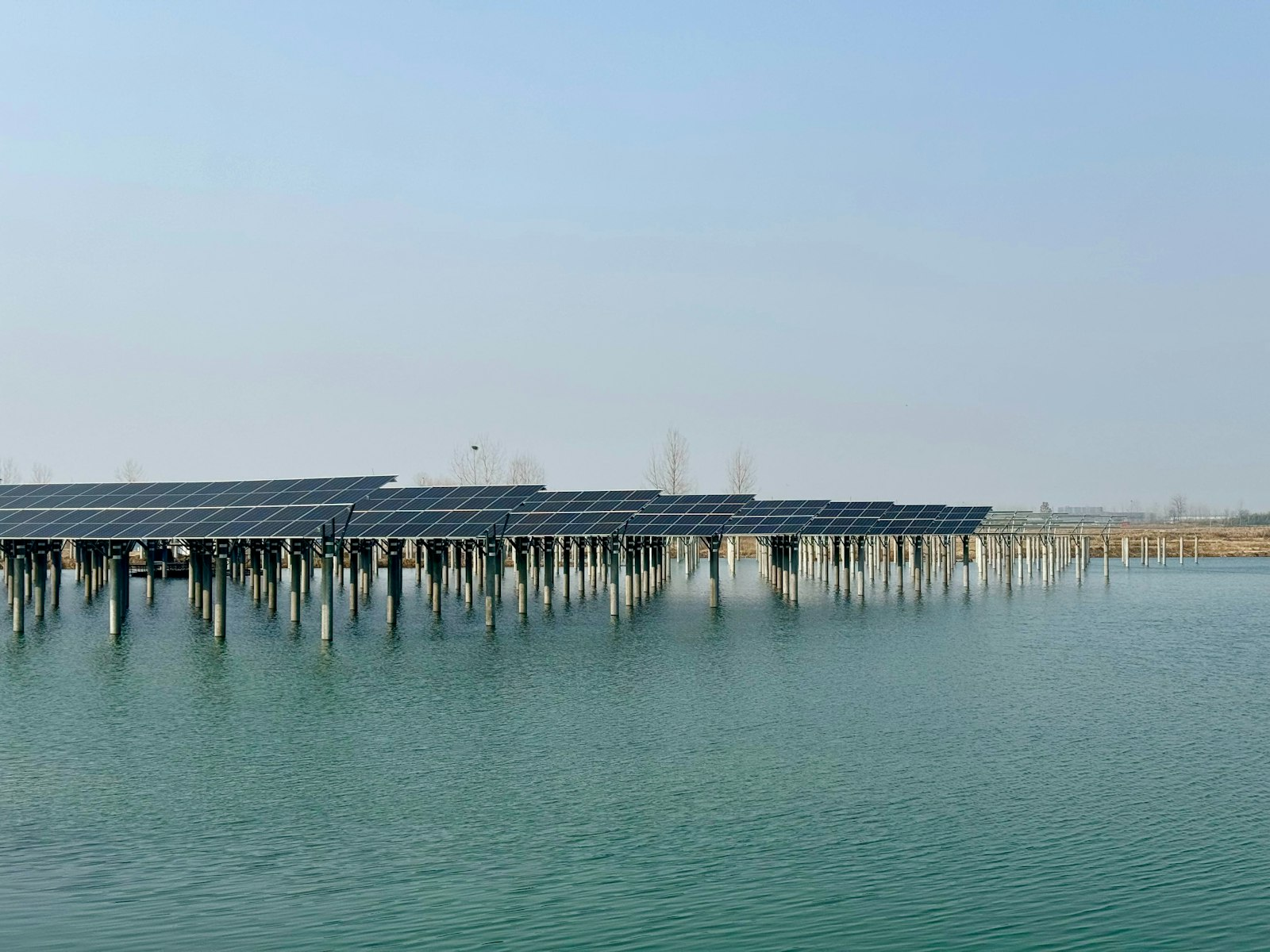
- Monroeville, Ohio (about 1,300 people) has installed a 6-megawatt floating solar array on its reservoir.
- It has 9,222 panels on three floating islands and feeds the village’s distribution grid.
- Gardner Capital owns it and sells the power to the village. Price and contract terms aren’t public.
- D3Energy built it and calls it the largest floating solar installation in Ohio and among the five largest in the United States.
Panels on the water instead of the farm
Gardner Capital owns the system and sells the electricity to the village, according to Interesting Engineering’s report. Appalachian Renewable Power, an Ohio firm, was the contractor. The array covers about 12 acres of water, though D3Energy’s project page lists the island at 11.1 acres.
The land angle is the interesting part. D3Energy says a similarly sized ground-mounted project would need roughly 30 acres of farmland. That’s a developer comparison, not land that was actually under threat. Interesting Engineering reports that about one-third of Ohio’s 88 counties have restricted large solar projects since a 2021 law gave counties more authority, and a floating array sidesteps that fight by using water the village already has. D3Energy managing director Stetson Tchividjian put it this way: “Monroeville had water sitting right there doing one job. Now it does two.”
A small village with a lot of solar
This isn’t the village’s first solar. It has had a 4 MW ground-mounted array operating since 2017. Counting both projects, D3Energy claims Monroeville has about 13 times Ohio’s overall solar capacity per resident. Note what that compares: installed capacity per resident, not electricity generated, and it’s D3Energy’s own calculation.
Why It Matters to You
Monroeville residents are the ones who could benefit, but no source says their bills will drop. The sources give no savings figure and don’t say how any savings would reach households, so anyone living there should ask the village council for the contract terms. For everyone else, the project is a small example of putting solar on water a community already has, rather than on farmland.
What isn’t known
- The sources give no annual output and no homes-powered figure.
- The price the village pays Gardner Capital, the contract length and any expected savings aren’t disclosed.
- Commissioning is unclear. Solar Power World reported in August that the array was expected online before the end of 2026, and D3Energy’s project page gives no date. Confirm the status with the village.
- The 13-times figure and the 30-acre comparison are both D3Energy’s.
Quick answers
Will Monroeville residents see lower power bills?
Unknown. No source gives a savings figure or says how any savings would reach households. Ask the village council for the contract terms.
Is the reservoir the village’s drinking water supply?
The sources describe a village reservoir and don’t confirm it is the drinking supply.
How does this compare with Lima’s array?
Lima’s is a 2 MW city-owned array on a drinking water reservoir. Monroeville’s is three times larger in capacity and privately owned. Both were developed by D3Energy.
Sources
- Interesting Engineering: report on Monroeville’s 6 MW floating solar array (Sep 16, 2026)
- D3Energy: Monroeville floating solar project page (accessed Oct 13, 2026)
- Solar Power World: Northwest Ohio community saves land space by siting solar project on reservoir (Aug 2026)