
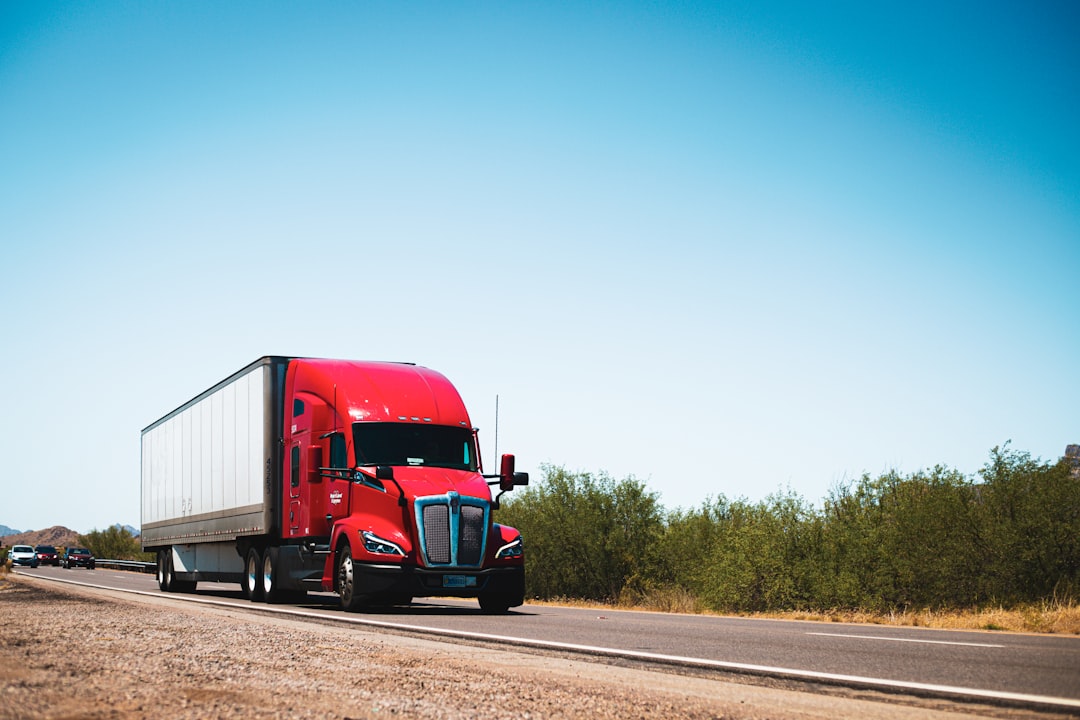
On September 8, 2026, Inceptio Technology announced that its systems have “surpassed 1 billion kilometers of commercial autonomous driving mileage.” The company supplies autonomous driving systems for heavy trucks in China, serving express delivery, cold chain, and general cargo fleets. At the equator’s length of about 40,075 km, one billion kilometers works out to roughly 25,000 laps around the Earth. That’s our arithmetic, not the company’s.
What Inceptio announced
The announcement came with a new product label, “Freight Physical AI.” Inceptio describes it as vehicle-level driving intelligence that accounts for heavy-truck physics, paired with a cloud platform for fleet management. The stated goals are route planning, fuel efficiency, and safety.
The company also made claims about its market position. It says its systems cover about 97% of China’s highway network and that it holds more than 90% of China’s autonomous trucking market. It says several express delivery companies made autonomous driving standard in their 2026 truck purchases. Outside China, it reports work in Europe, Japan, and the Middle East, including a pilot at the Port of Antwerp-Bruges.
Inceptio reported 100 million km in 2024 and 200 million km later that year, according to earlier coverage we reviewed, so 1 billion km is five times the 200 million km mark. A 2024 company release cited more than 2,000 Inceptio-powered trucks in Chinese logistics fleets, and the September 2026 announcement gives no current fleet size.
What holds up and what doesn’t
| Works well | Be careful |
|---|---|
| A reported mileage trail: 100 million km and 200 million km in 2024, then 1 billion km in 2026 | The 1 billion km figure is the company’s own, with no independent verification |
| Driverless work is listed separately: a May 2026 pilot of driverless light-duty trucks with SF Express, and Level 4 testing of heavy-duty trucks with JD Logistics on open roads | The core product is described as “L2+” line-haul assistance, and the announcement doesn’t say whether a human driver supervised the truck for that distance |
| Level 4 permits held in Zhejiang, Beijing, and Hainan | No safety rate: no crash or incident figures and no human-driver benchmark |
| Claimed reach of about 97% of China’s highway network and more than 90% of the autonomous trucking market | Those are company claims. They show reach, not safety, and not how often a human is in control |
The mileage is real as a claim and unproven as a safety record. A 2024 company release cited a joint study with insurer CPIC that found the trucks performed 75 to 99 percent better than human-driven trucks across several indicators, but it gave no raw accident rates, so we can’t judge the comparison. Treat the 1 billion km as a measure of scale.
Why It Matters to You
This is mostly a story about trucking companies, not about drivers on the road next to you. Express delivery, cold chain, and general cargo fleets in China are the ones using the systems, and several express delivery companies made autonomous driving standard in their 2026 truck purchases. For everyone else, the sources don’t show a direct benefit yet, and claims about fewer delayed shipments, lower insurance costs, or lower shipping rates aren’t supported. If the driverless pilots and Level 4 tests mature, fleet operators would feel it first.
Quick answers
Are Inceptio’s trucks driverless? Mostly not, based on how Inceptio describes its products. Its main line-haul product is described as L2+ driver assistance. Driverless operation appears in pilots, such as the May 2026 SF Express light-duty trial, and in Level 4 testing.
Does 1 billion km prove autonomous trucks are safer? No. Distance alone isn’t a safety measure. A safety claim needs crash or incident rates, a clear comparison group, and a stated time period, and the announcement provides none of those.
What is Freight Physical AI, and does 97% highway coverage mean the trucks drive themselves on 97% of roads? Freight Physical AI is Inceptio’s name for its new combination of truck-specific driving software and a cloud fleet platform, which the company says supports route planning, fuel efficiency, and safety. The 97% figure describes where the system can be used, not how often a human driver is supervising or in control.
Sources
- CCJ: Autonomous tech company hits 1 billion kilometers (Sep 8, 2026)
- Unite.AI: Inceptio coverage of the 1 billion kilometer milestone and Freight Physical AI (PR Newswire release, Sep 8, 2026) (accessed Oct 13, 2026)
- Traffic Technology Today: Inceptio-powered AV trucks surpass 200 million kms in commercial operations (accessed Oct 13, 2026)