
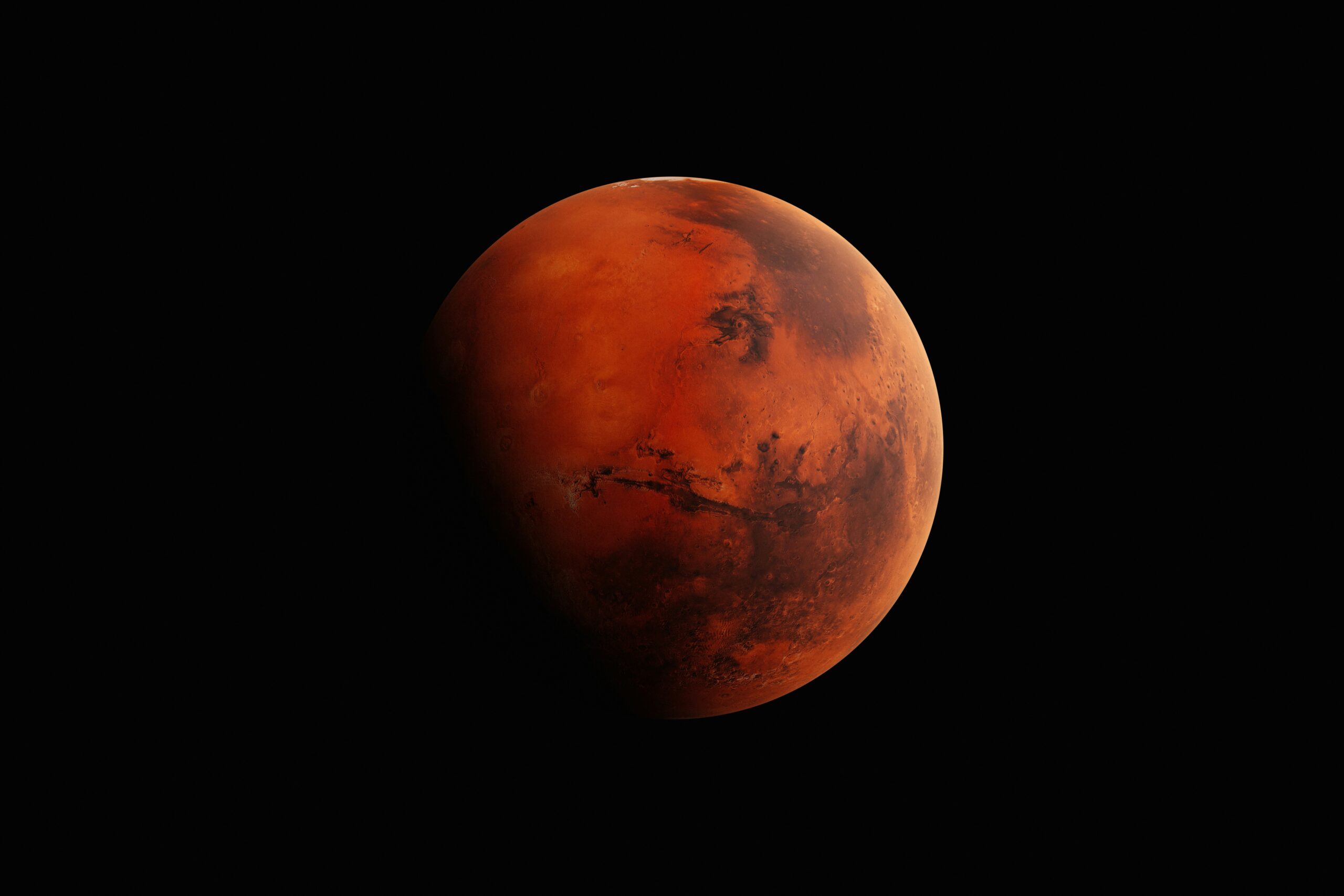
Two small NASA spacecraft each fired an engine for about nine minutes this month, two days apart, as they swept past Earth. Those burns sent them toward Mars. NASA reported the maneuvers complete on Nov. 9, 2026. The flybys are verified. Everything at Mars is still a plan, with arrival set for September 2027.
This is the ESCAPADE Mars mission. Its two probes, named Blue and Gold, will study how the solar wind affects the Martian environment. We read NASA’s update and a New Space Economy summary to check the details below.
Two Burns, Two Days Apart
A powered flyby combines two things: Earth’s gravity and a sustained engine burn. NASA says the pair did this on Nov. 7 and Nov. 9, and calls it the first time the agency has used a powered Earth flyby to send a spacecraft to Mars. That “first” is NASA’s claim. We did not verify it independently.
| Spacecraft | Closest approach (EST) | Height above Earth | Burn length |
|---|---|---|---|
| Spacecraft 1 | 5 a.m., Nov. 7 | About 1,000 miles | About 9 minutes |
| Spacecraft 2 | 6 a.m., Nov. 9 | About 650 miles | About 9 minutes |
Source: NASA Science, Nov. 9, 2026. Figures are NASA’s.
NASA’s Asal Naseri said the team did the maneuver twice “flawlessly, in just two days.” Jeff Parker, lead mission designer at Advanced Space, said the method gives “the flexibility to launch almost anytime and then use Earth’s gravity to get a boost to Mars.”
Why the Trip Took a Year
The spacecraft launched from Cape Canaveral on Nov. 13, 2025. At that time, Earth and Mars sat on opposite sides of the Sun. A direct trip was not possible. So the pair waited in a looping path around a point about a million miles from Earth, on the side facing away from the Sun.
NASA says they did useful work while they waited. They flew through Earth’s magnetotail several times. That is the long, stretched tail of Earth’s magnetic field. New Space Economy says the launch used a Blue Origin New Glenn rocket, and NASA lists Blue Origin as a mission partner. Rocket Lab built the spacecraft, per New Space Economy. For more space news on this site, see our report on Starship Flight 15.
What Comes Next at Mars
NASA plans a cruise of about ten months. Orbit insertion burns, each about 11 minutes, are scheduled for Sept. 7 and Sept. 9, 2027. Science work is expected to start in June 2028. The two probes will first fly one behind the other. Six months later, they split. One moves farther out to watch the incoming solar wind. The other moves closer to see how Mars responds. That campaign is planned to last five months.
Rob Lillis, the principal investigator at UC Berkeley, said it will be “the first science mission to choreograph two orbiters around Mars.” Again, that describes the plan, not a result.
What Is Not Settled Yet
The hardest part is still ahead. Each spacecraft must fire its engine at Mars and be captured into orbit. Every date after November 2026 is a plan. NASA’s page does not state a mission cost, and it does not describe any problems with the burns beyond the “flawlessly” quote. The New Space Economy article summarizes NASA’s material, so our confirmation rests mainly on NASA itself. Trajectory corrections will happen along the way, with no dates given.
Why It Matters to You
The mission studies how the solar wind, a stream of charged material from the Sun, helps strip Mars of its atmosphere. NASA’s Michele Cash says that understanding this could help plan future human missions. There is no direct benefit for people on Earth yet. The payoff, if it comes, will be science data starting in 2028.
Sources
- NASA Science (Vanessa Thomas), “NASA’s ESCAPADE Completes Powered Earth Flybys, Now En Route to Mars”, Nov. 9, 2026
- New Space Economy, “ESCAPADE Completes Powered Earth Flybys and Begins Its Cruise to Mars”, Nov. 10, 2026
Related Reading
- Starship Flight 15 Catches Its Ship, Loses Its Booster
- More space technology coverage on this site
- NASA Science: ESCAPADE completes powered Earth flybys
- UC Berkeley Space Sciences Laboratory: About ESCAPADE
Watch for September 2027. Two burns of about 11 minutes each will decide whether the long way around pays off.