
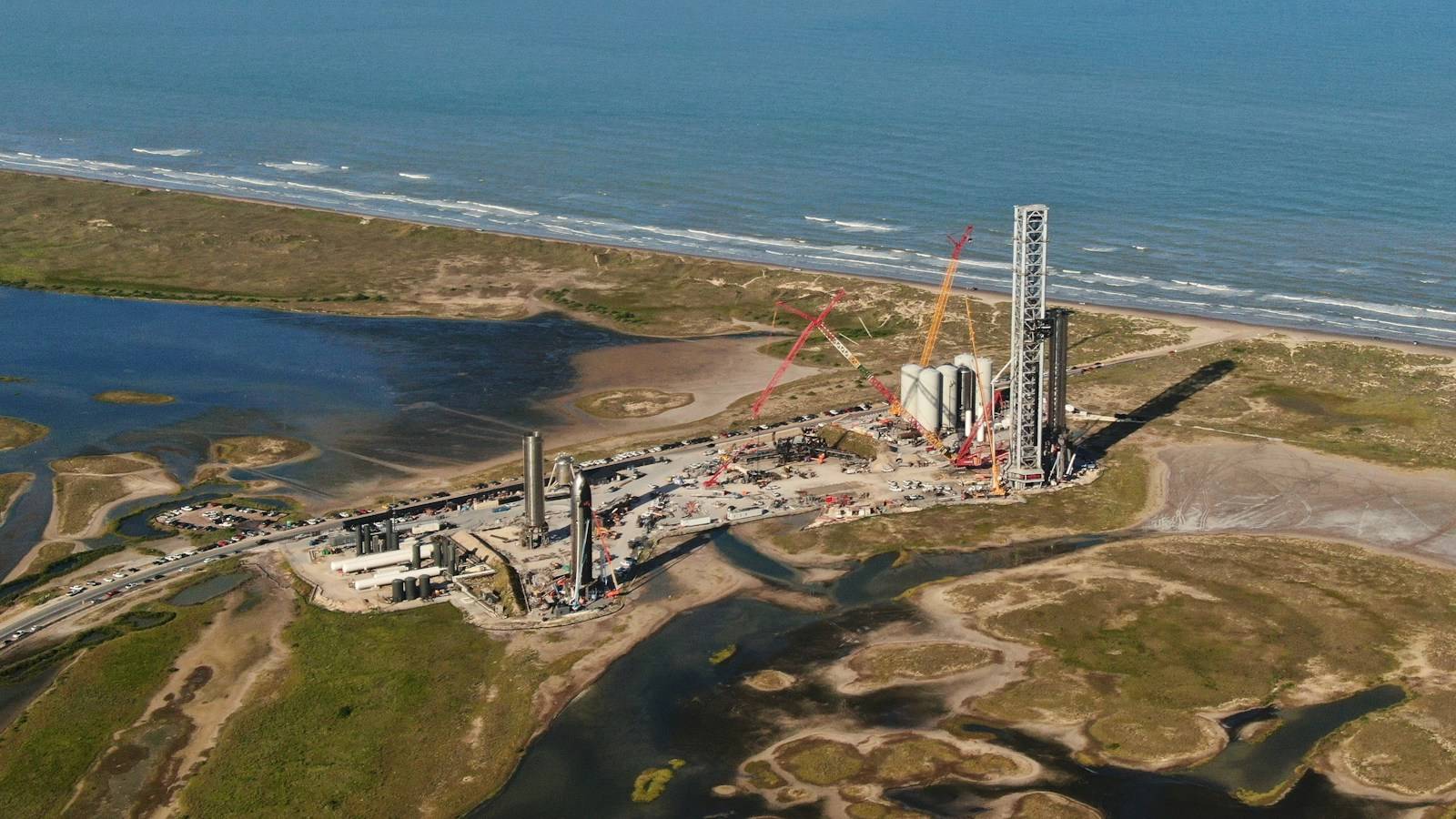
Starship Flight 15 gave SpaceX half of the result it wanted. On Saturday, Nov. 14, the launch tower’s mechanical arms caught the Starship upper stage after a trip around the planet. The giant booster that launched it did not make it back. This post separates what happened from what is still unproven.
Everything below comes from outlets that watched the livestream and quoted SpaceX staff. SpaceX’s own web pages returned no Flight 15 details when we opened them, so the company’s words reach us through Space.com and Weatherboy.
What Flew From Starbase
Starship is a two-part rocket. The Super Heavy booster does the heavy lifting off the ground. The Starship upper stage, called the ship, carries the payload into orbit. Orbit means circling Earth fast enough that the craft keeps falling around the planet instead of toward it.
According to Space.com’s live blog, liftoff came on Friday, Nov. 13, at about 5:47 p.m. EST from Starbase, Texas. SpaceX’s Dan Huot called it the longest Starship mission the company has flown, per the same blog. The plan was about 14 orbits over roughly 22.5 hours.
The Booster That Did Not Come Home
The plan was a “double catch”: both stages returning to the tower. Booster 22 never got there. Space.com reports it diverted to a splashdown in the Gulf of Mexico after a low-fuel alarm. Weatherboy adds that its flight termination system fired and the booster was destroyed over the Gulf.
Weatherboy quotes SpaceX saying the booster relit 32 of its 33 engines for the boostback burn, and that the burn ended early due to low fuel mass. SpaceX’s Kate Tice said on the webcast that early indications pointed to the low-fuel alarm, with the root cause still under investigation. Early in the day, the webcast had blamed a guidance issue. Huot later said that was not the cause.
The Ship Comes Back to the Tower
The ship, Ship 42, did its job in orbit. Space.com reports it reached orbit about 26 minutes into the flight. Weatherboy reports it released 26 Starlink V3 satellites about 40 minutes after liftoff, and that SpaceX said it made contact with every one. KeepTrack, a space-tracking outlet, reports three of the 26 carry cameras to inspect the ship’s heat shield.
The ship then coasted for more than 20 hours. Flight controllers passed on three chances to bring it down early in the ocean, according to Space.com. After a short deorbit burn, the ship re-entered the atmosphere and flew back to the pad. At about 4:20 p.m. EST on Nov. 14, the tower arms closed around it. Space.com describes this as the first catch of a Starship upper stage.
| Part of the flight | Reported result |
|---|---|
| Launch and ship orbit | Completed, about 275 km planned orbit |
| Starlink V3 deployment | 26 satellites released, contact made with all |
| Ship return and tower catch | Completed after about 22.5 hours |
| Booster tower catch | Not achieved, lost over the Gulf of Mexico |
Source: Space.com and Weatherboy, Nov. 14 and 16, 2026. Figures are as reported by those outlets from SpaceX statements.
What Is Still Unproven
One caught ship is not a reused ship. Nothing in the coverage says Ship 42 will fly again, or how much work it needs first. The booster loss is unexplained beyond early indications. Weatherboy reports that as of Sunday it found no FAA statement on whether the booster loss would require a mishap investigation. SpaceX has not announced a date for Flight 16, per the same report.
Outlets also disagree on small details. Space.com’s blog gives the planned orbit as about 275 kilometers but mentions 260 during the coast. Early reports on the FAA license scope differ between sources too, so we leave that point out.
Why It Matters to You
Starlink is a satellite internet service, and V3 is the larger next generation SpaceX wants to launch on Starship. If ships can land and fly again quickly, launches could get cheaper and more frequent. That is a goal, not a result yet. For now, 26 V3 satellites are in space, and the tower catch shows the return method works once.
Sources
- Space.com, live blog “SpaceX Starship Flight 15 live updates”, updated Nov. 14, 2026
- Space.com (Mike Wall), “‘Now everything changes’: SpaceX catches Starship upper stage for 1st time ever”, Nov. 14, 2026
- Space.com (Tariq Malik), report on the aborted booster catch, Nov. 14, 2026
- Weatherboy, “SpaceX Tower Arms Catch Starship Upper Stage for First Time”, Nov. 16, 2026
- KeepTrack, “Starship Flight 15 Booster Catch Called Off”, Nov. 14, 2026
- Seeking Alpha, “SpaceX Flight 15 booster diverts to splashdown, missing planned double catch”, Nov. 13, 2026
Related Reading
- More space technology coverage on this site
- Technologies of Tomorrow
- Space.com: SpaceX catches Starship upper stage
- KeepTrack: Starship Flight 15 booster catch called off
Watch for the Flight 16 date and the booster’s root-cause finding. Those two answers decide how soon a caught ship can become a reused one.