
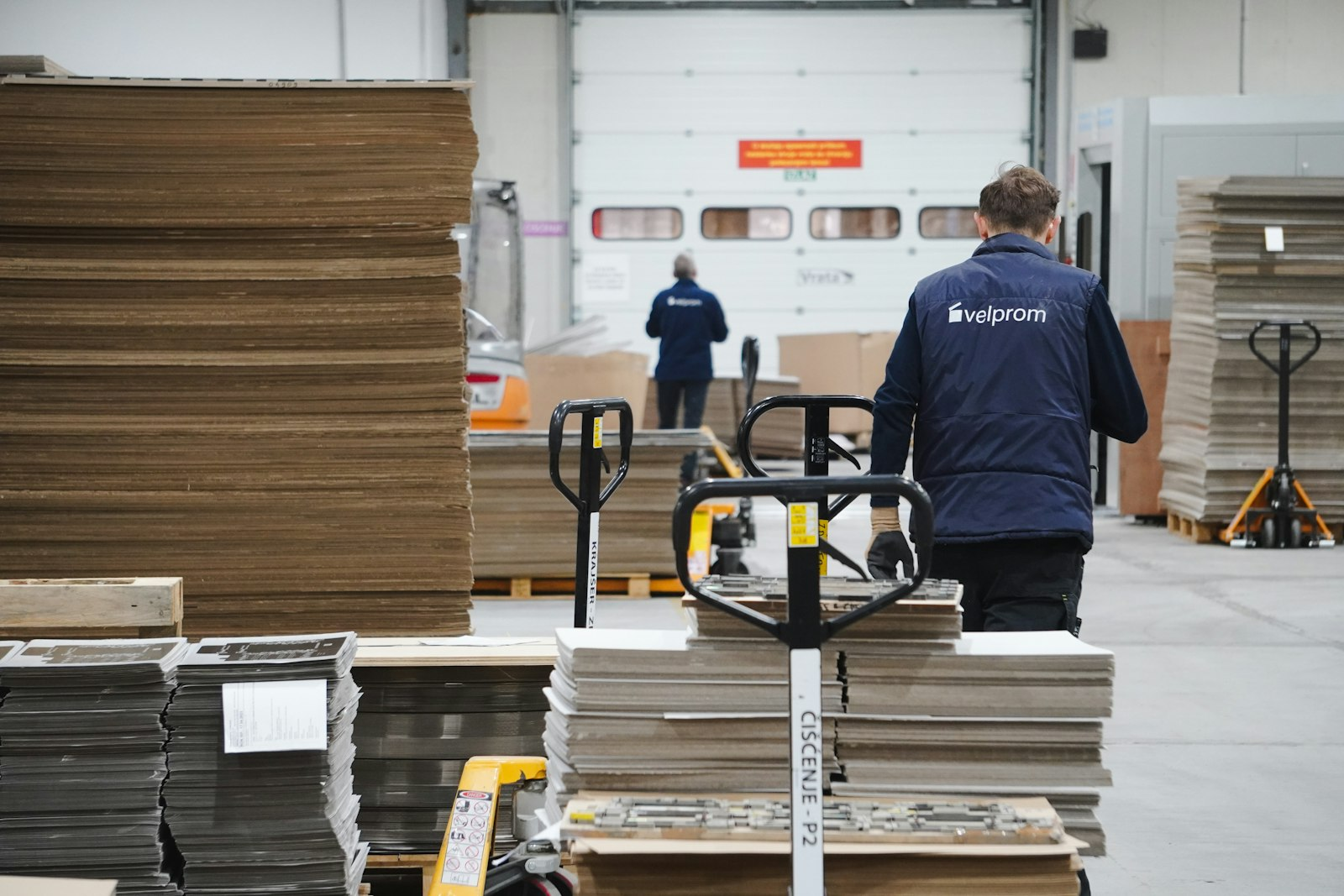
Robust AI says human warehouse workers can walk about 30,000 steps in a day. That figure, reported by MIT News on November 13, 2026, is the problem the company built its Carter warehouse robot to ease. Carter is a wheeled cart that drives itself, yet any worker can grab its handlebar and steer it. MIT News says it is deployed in logistics warehouses and on factory floors today. Neither source gives independent results.
What Carter Does on the Floor
According to MIT News, Carter looks like a utility cart on wheels. It has a force-sensitive handlebar, an AI-powered vision system and holonomic wheels. Holonomic wheels let a cart slide sideways as well as forward, which helps in tight aisles.
The robots help with picking or stocking shelves and moving items across a facility on their own. Robust AI describes Carter on its product page with a 100 kg (220 lb) payload and 18 hours of operating time. Those are company specifications, not tested results.
Who Stays in Charge
The design choice worth noticing is the handlebar. MIT News says a worker can push or pull Carter in any direction with one hand, or direct it with gestures or the onboard touch screen. A worker can also say “done” and the robot comes to them.
Co-founder Rodney Brooks told MIT News: “We let humans do what humans are good at in the physical world.” He also said how the robots fit into a workspace is “entirely up to the customer.” In other words, supervision is built in, and each site decides the rules.
A Lesson From Hospital Robots
Robust AI’s team points to a cautionary tale. Leila Takayama, the company’s vice president of human robot interaction, recently found a peer-reviewed study of hospital robots, MIT News reports. In it, a large number of robots sat switched off against walls, and nurses said they broke. The article does not name the study, so we could not check it.
Brooks drew a plain lesson: the robots were getting in the way of nurses’ main tasks. Carter’s handlebar is partly a response. A robot that people can easily move aside is less likely to end up parked in a corner.
What Is Missing From the Record
This is a company profile, not a field study. MIT News gives no error rates, injury data or measured time savings. Neither source lists a safety certification. The company’s homepage promises a no-capital-cost, all-inclusive service, “zero infrastructure changes” and a “Day-1 ROI.” Those are marketing claims, and no pricing or customer results back them up.
The homepage lists DHL Supply Chain, ShipLab eCommerce Fulfillment and Aptiv among customers and partners. It does not say how many Carters each runs or whether those sites are pilots. The 30,000-step figure is also Robust AI’s framing, and we found no independent measurement of it.
Robot rollouts in public spaces face similar questions. Our piece on DoorDash’s Dot delivery robot test in Salt Lake City shows what a city-set reporting requirement looks like.
Who Benefits and How
- Warehouse and factory crews could walk less, if sites actually use Carter for long hauls. That benefit is claimed, not yet measured.
- Employers get a robot sold as a service. Whether it pays off is unproven in public data.
- Workers keep control. They can override Carter by hand, which matters for safety and for trust.
- It is not for sale off the shelf. Robust AI lists an email contact only.
One question to ask at any site that adds robots like this: who decides where the cart goes, and who can say no?
Sources
- MIT News, “Helping robots fit into the human workplace,” by Zach Winn, November 13, 2026
- Robust AI, company homepage, viewed November 14, 2026
- Robust AI, Carter product page, viewed November 14, 2026