
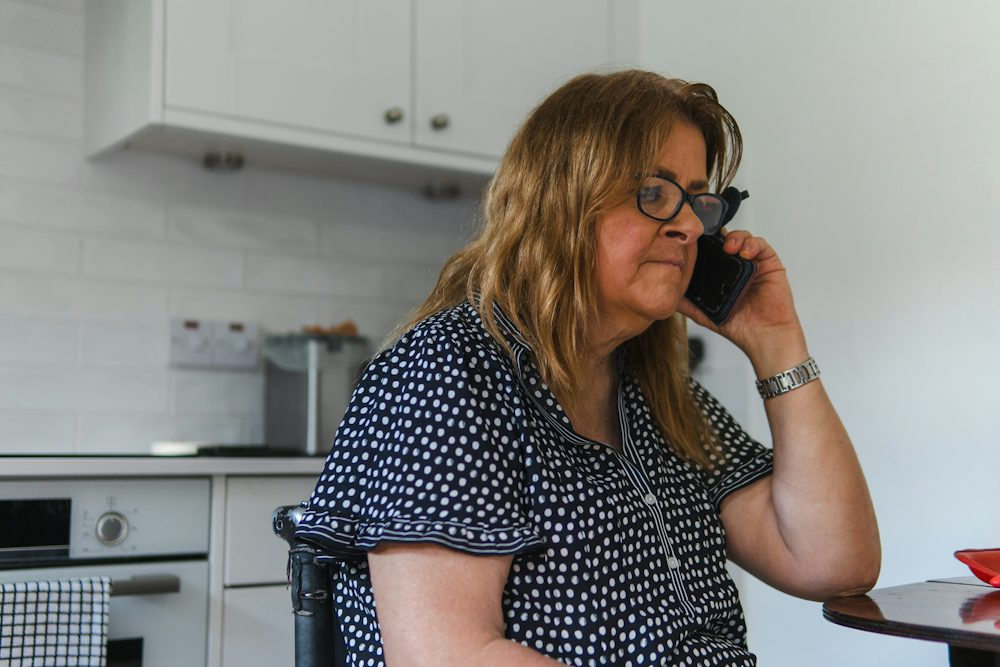
An NHS AI phone assistant called Dora Care is now checking in on patients with osteoporosis, a bone-weakening condition that affects about 3.5 million people in the UK. Newcastle University and the University of York announced the two-year trial in the first week of November 2026. It pairs generative AI with the kind of routine check-up call a nurse or clinic coordinator already makes between in-person appointments, and it already has medical and ethical approval in place.
How the Calls Are Built to Sound Human
Osteoporosis mostly affects women and people over 50, and a phone call about bone health can land at a moment when someone already feels frail or anxious. So before writing a single line of Dora Care’s script, the project team tried to answer a narrower question: what makes a clinician’s phone manner feel caring in the first place?
Linguists at Newcastle University studied how human clinicians build empathy into a call, not just their word choice, but their tone and the exact moment in a conversation they choose to show concern. They then worked those patterns into how Dora Care talks.
“We started with a question of ‘how might a patient experience being empathised with’,” said Dr. Adam Brandt, a senior lecturer in applied linguistics at Newcastle University.
Researchers at the University of York, who are running a parallel safety review, frame the open question plainly: nobody yet knows for certain whether an AI voice can feel genuinely reassuring to someone who is frightened or in pain, or whether it can gather the right clinical details without a trained person on the other end of the line. Professor Ibrahim Habli, research director at York’s Centre for Assuring Autonomy, said any AI used in a healthcare setting “must be backed by robust safety evidence and assurance,” adding that even a well-tested tool can sit unused if clinicians don’t trust the safety case behind it.
Dora Care Already Has a Track Record in the NHS
Dora Care is not a first attempt. It is built on Dora, an AI phone system from the Oxford company Ufonia that already runs patient follow-up calls across 16 NHS trusts and regions, including Buckinghamshire, Oxfordshire, Berkshire West, Hampshire, and the Isle of Wight. A case study published by SBRI Healthcare says Dora has completed more than 75,000 of those consultations to date, mostly checking in on people after cataract surgery, and resolves up to 70 percent of those calls on its own, without a clinician needing to step in.
The new osteoporosis work extends that approach to fracture liaison services, the NHS clinics that track people after a bone fracture to prevent the next one. The project announcement says many of those clinics are short-staffed across parts of the UK, while fracture-related treatment costs the NHS an estimated £4.5 billion a year.
What’s Not Yet Proven
- No results yet. A public clinical trial registry listing shows the osteoporosis study enrolling roughly 217 patients, running from February 2026 through December 2027, so there is no published data yet on accuracy, patient satisfaction, or how often Dora Care’s read of a patient’s situation matches a clinician’s own judgment.
- Narrow eligibility for now. The trial excludes patients with severe cognitive impairment, anyone already stabilized on long-term osteoporosis treatment, and people with a terminal prognosis under 12 months, so early results may not say much about how the tool performs for everyone living with the condition.
- Empathy is being tested, not assumed. Researchers describe whether patients will find an AI caller genuinely reassuring as an open question the trial is meant to help answer, not a settled fact.
- A commercial product, publicly funded. The project is funded in part by Innovate UK, a UK government agency, but Ufonia is a private company that stands to benefit if the NHS adopts Dora Care more widely.
Why It Matters to You
If you or someone you care for is managing osteoporosis, the appeal here is simple: a check-in call over an ordinary phone, with no app, account, or smartphone required. That matters most for older patients who may not use a smartphone at all. Done well, it could mean a missed medication or a new fall gets flagged between appointments instead of waiting for the next scheduled visit, weeks or months later.
Participation in the trial is voluntary, and for now the calls supplement a patient’s normal NHS care rather than replacing it. If the approach proves safe and reliable, the team behind it says the same model could extend to monitoring other long-term conditions, including diabetes, heart failure, and COPD.
Would you trust a phone call like this to check in on your own health, or is that still a job you’d rather leave to a person? The answer may depend less on the technology than on how well Dora Care’s two years of real calls back up what its designers are promising now.
Sources
- Newcastle University: NHS trials AI phone assistant for patients with long-term illness (Nov. 6, 2026)
- University of York: NHS trials AI phone assistant to monitor patients with long-term illness (Nov. 5, 2026)
- HyperAI: NHS Trials AI Phone Assistant to Monitor Chronic Illness Patients
- SBRI Healthcare: Ufonia impact case study
- Clinical trial registry: Evaluation of Dora Care for Supporting Fracture Liaison Services