
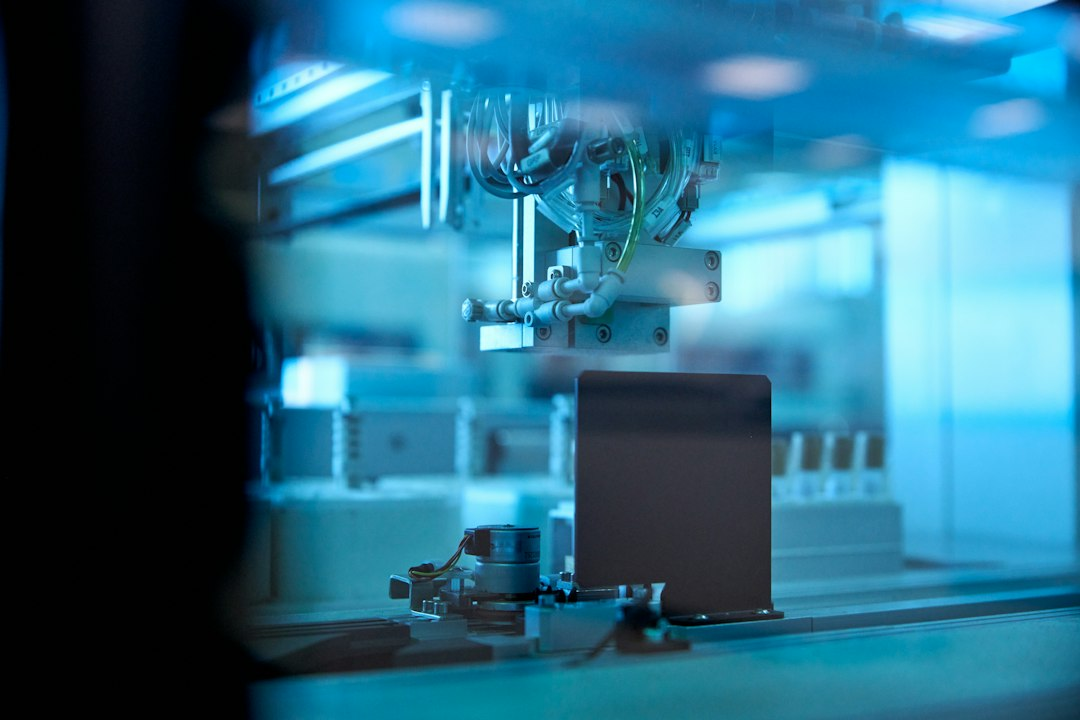
Kairos Power is now laser-engraving barcodes into its nuclear fuel pebbles. Each mark goes about half a millimeter deep, carved into graphite, invisible unless you go looking for it. The company says it opened a new fuel pebble inspection and tracking system this month at its Manufacturing Development Campus in Albuquerque, New Mexico. World Nuclear News reported the details on October 14, and Kairos Power’s own list of company updates confirms it announced the system on October 7.
I could not load Kairos Power’s original announcement directly. The page returned a server error during this reporting. So the specifics below come from World Nuclear News’s coverage and from Kairos Power’s public update listing, which verifies the headline and the October 7 date.
How the fuel pebble inspection line works
Here is what Kairos says happens to every pebble before it goes anywhere near a test reactor.
- Measure it. Machines check each pebble’s diameter, geometry, and density in real time, before it is packed or loaded into test hardware.
- Scan the surface. High-precision lasers scan the outside of the pebble down to the micron level, checking for cracks or other structural flaws.
- Mark it. An infrared laser etches three small data matrix codes into the graphite surface. Each one reaches about half a millimeter deep, shallow enough to leave the pebble’s outer shell intact.
- Record it. The code links to a file with that pebble’s dimensions, density, batch number, and inspection history, all in one place.
None of this touches a working reactor yet. It is quality control for a part that, at full scale, Kairos will need to make by the hundreds of thousands. The company says the data will help engineers measure fuel consumption more precisely and track material as pebbles move through testing and, eventually, operation.
Why a reactor needs barcoded fuel
Kairos is building the KP-FHR, short for fluoride-salt-cooled, high-temperature reactor. Instead of solid fuel rods, it circulates graphite pebbles, each about the size of a billiard ball, through a bath of molten fluoride salt. In a working reactor, each pebble would hold thousands of TRISO fuel particles: tiny uranium kernels wrapped in layers of carbon and ceramic.
At the Albuquerque campus today, Kairos is mostly working with surrogate pebbles. These are solid graphite stand-ins and annular, or ring-shaped, versions that mimic the TRISO layer without live fuel inside, while the company refines how to make the real thing. In a separate June update, Kairos said its automated line for those surrogate pebbles had reached 950 pebbles a day, more than three times its old manual rate. The new inspection system is the next link in that same chain. Once you can make pebbles fast, you need a fast way to check that each one is good enough to use.
Fuel handling problems are not abstract. In September, workers at the Palisades plant in Michigan tilted a fuel assembly while loading it into the reactor, a mistake that forced operator Holtec to file an emergency license amendment just to retrieve the assembly. That is a conventional light-water reactor with a completely different fuel design, but it shows what one handling error can cost: weeks of regulatory review and a delayed restart. Traceable, individually inspected pebbles are Kairos’s bet against that kind of problem showing up in its own fuel line.
Kairos is not the only group racing to get pebble fuel right. Oak Ridge National Laboratory is five years into a $27 million partnership with Kairos studying how TRISO pebbles hold up over their full lifecycle, not just how they get made. Chris Petrie, the lab’s interim nuclear fuel development lead, has described the goal as pairing ORNL’s expertise with what he called Kairos’s “iterative approach to progressively demonstrating the technology,” a way to learn fast without waiting for a finished commercial plant.
Kairos has also been testing other pieces of its commercial playbook, including robotic remote maintenance gear for its planned Hermes 2 plant, while a separate company, TRISO-X, is racing to finish its own dedicated TRISO fuel plant down the road in Oak Ridge. Fuel supply, not just fuel design, remains one of the biggest open questions facing every advanced reactor developer.
The inspection system, by the numbers
- Location: Kairos Power’s Manufacturing Development Campus in Albuquerque, New Mexico.
- Near-term target: 70,000 pebbles inspected, Kairos says, feeding test platforms including the company’s second engineering test unit, ETU 2.
- Engraving depth: about half a millimeter into the pebble’s graphite surface, per Kairos.
- Codes per pebble: three data matrix codes, each tied to a single inspection record.
- Downstream plant: Hermes 2, Kairos’s power-producing demonstration reactor, which broke ground in Oak Ridge, Tennessee, in April 2026, according to World Nuclear News.
What we don’t know yet
- Kairos has not published an error rate or any independent audit of the inspection system’s accuracy.
- There is no published date for when the system will reach its 70,000-pebble target.
- The pebbles being inspected now are surrogates and test components, not yet licensed commercial reactor fuel.
- I could not open Kairos Power’s own announcement directly, so the figures above rely on World Nuclear News’s report and the company’s public update listing.
- No outlet besides World Nuclear News appears to have reported independently on this specific system as of this writing.
Why It Matters to You
If you do not work in a nuclear fuel plant, this story will not change your electric bill tomorrow. But it is a small, unglamorous piece of a much bigger bet: that advanced reactors like Kairos’s KP-FHR can get built on budget and on schedule, instead of slipping for years the way some earlier nuclear projects did. Catching a flawed pebble on an inspection line, before it ever goes near a reactor core, is cheaper and safer than catching it afterward.
For communities near Oak Ridge, Tennessee, where Hermes 2 is under construction, and for workers at the Albuquerque plant, that shows up first as fewer costly do-overs. For everyone else, it is one more data point on whether a new generation of smaller, factory-built reactors can actually hit their price and timeline targets, something that would eventually shape electricity costs if these plants start supplying real power. None of that is guaranteed yet. Hermes 2 has not produced a watt of electricity, and Kairos gives no cost figure tied to this inspection system specifically.
Watch for two things next: whether Kairos actually hits that 70,000-pebble mark, and whether Hermes 1, the non-power demonstration unit at the same Oak Ridge site, starts up anywhere close to schedule. A barcode on a fuel pebble is a small thing. Whether it adds up to a reactor that ships on time is the real test.
Sources
- World Nuclear News: Kairos Power automates fuel pebble inspections (Oct 14, 2026)
- Kairos Power: company updates listing, confirming the October 7, 2026 announcement (accessed Oct 14, 2026)
- Kairos Power: Kairos Power Ramps Up Pebble Production with New and Improved Automation Process (Jun 24, 2026)
- ANS Nuclear Newswire: TRISO pebble lifecycle studied in new ORNL, Kairos Power partnership (Feb 23, 2026)
- ANS Nuclear Newswire: NRC reviews LAR on Palisades fuel loading incident, as Pioneer SMR application advances (Oct 8, 2026)