
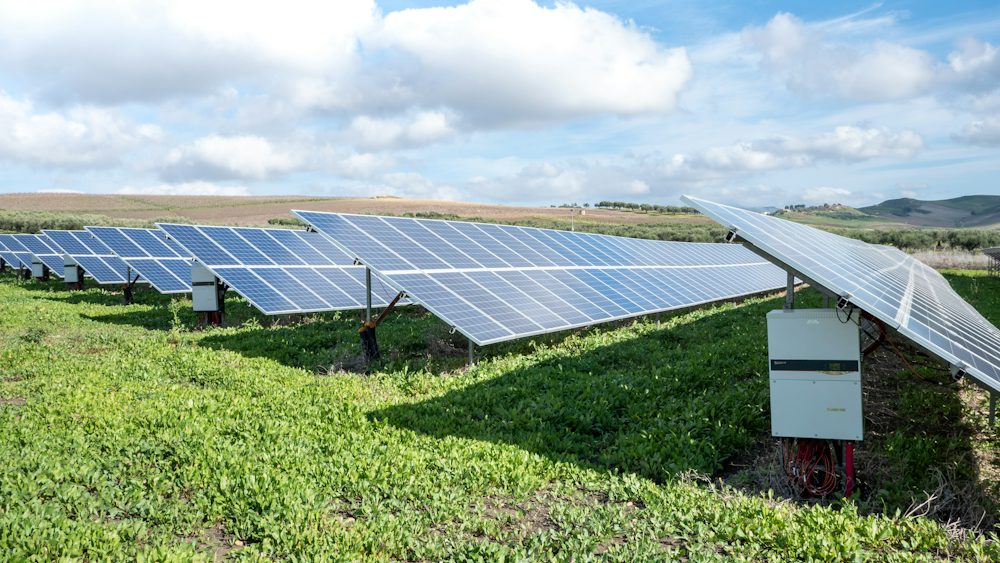
Nine years ago, a newspaper column described a nursery owner’s plan to put a Concord NH solar farm on a patch of unusable farmland. On Friday, that plan finally switched on.
Governor Kelly Ayotte and Concord Mayor Byron Champlin joined developer Lodestar Energy at Brochu Nurseries for a ribbon-cutting on Nov. 13 marking the completion of the LSE Ursa Minor solar project. The array is now sending power into the regional grid. Lodestar and panel maker Silfab Solar report it will generate more than 9 gigawatt-hours of electricity a year, which they say is enough to cover the annual use of about 1,000 U.S. homes while avoiding roughly 1,500 gas-powered cars’ worth of emissions.
Inside the New Concord NH Solar Farm
The array’s roughly 11,000 panels sit on about 30 acres of a parcel along the Merrimack River that the Brochu family has owned since the 1970s, according to Concord Monitor’s reporting. At nearly 5 megawatts AC, it’s the largest size New Hampshire’s net metering law allows for a single array connected this way. Lodestar built it with panels made at Silfab’s factories in South Carolina and Washington state, a point the company stressed at the ribbon-cutting as a selling point for the schools and towns buying its power.
The land itself has a backstory. Len Brochu Sr. bought the parcel decades ago and tried growing a pine grove there for log homes. Disease wiped the trees out, and the soil turned out too silty and sandy for nursery stock. A solar farm, in other words, was about the only thing that made sense for that corner of the property. The family nursery keeps operating on the rest of the land.
From Idea to Ribbon-Cutting
Getting here took far longer than building the thing. Based on Concord Monitor’s reporting:
- Around 2017: Columnist David Brooks first wrote about the Brochu family’s interest in putting solar on the unproductive parcel.
- 2024: State and city officials approved the project, clearing the way for construction to begin.
- Along the way: New Hampshire’s stormwater rules treated the ground-mounted array like one large building instead of spaced-out rows of panels, triggering runoff calculations that developers say have killed other proposed solar projects in the state. Regulators eased those rules somewhat around the time of approval.
- Dec. 15, 2025: Local and state leaders gathered for an official groundbreaking.
- Nov. 13, 2026: Lodestar, the Brochu family and state officials cut the ribbon on the finished array.
Clean Energy New Hampshire, a nonprofit that worked with Lodestar on the project, says the state’s permitting rules have gotten more realistic in recent years but still lag some neighboring states. The group’s director put it bluntly to Concord Monitor: building solar in New Hampshire remains harder than it should be, even on a site built for it.
Who Actually Gets the Power
This isn’t the kind of community solar program where a homeowner signs up for bill credits. New Hampshire law limits arrays this size to selling power only to government agencies and nonprofits, known as offtakers, under long-term contracts. Readers curious how that compares to residential programs can see how community solar subscriptions typically work state by state.
Concord Monitor’s reporting on this project and a similar array the city finished on its capped landfill around the same time names the offtakers for the two arrays combined: Concord’s municipal government, the city’s public schools, state government offices, the New Hampshire Housing Finance Authority, the McAuliffe Discovery Center, and, notably, the Exeter school district, which buys power through the same utility, Unitil, even though it sits outside Concord.
Lodestar and Silfab say the Brochu project alone should generate more than $1 million in local electrical grid upgrades, more than $1 million in new tax revenue for Concord, and more than $1 million in net metering credits for the schools and government offices that signed on as offtakers.
Why It Matters to You
- If you pay property taxes in Concord: the company’s reported $1 million-plus in new tax revenue, once it materializes, is money the city didn’t have from this parcel before.
- If your kids go to school in Concord or Exeter: locking in solar credits for a school district can soften year-to-year swings in energy costs, which matters when energy is competing with everything else in a school budget.
- If you run a farm or nursery with land you can’t use: the Brochu family’s experience shows a fallow, degraded field can become steady income without giving up productive cropland.
- If you live in another New Hampshire town watching from the sidelines: this project is a real example of how long the permitting path can take, and local officials elsewhere can use it to push for faster reviews.
What We Don’t Know Yet
- Lodestar and Silfab’s announcement doesn’t say how many years their $1 million-plus benefit figures are projected over.
- It isn’t clear how the output and credits split between the Brochu array and the similarly sized array on Concord’s capped landfill.
- No one has published what the project cost to build.
- Homes-powered estimates vary by source. Lodestar and Silfab put it at about 1,000 homes a year; an earlier Concord Monitor estimate from December put the same array at “at least 5,000” homes, depending on the assumptions used.
Frequently Asked Questions
Can a Concord homeowner sign up for credits from this solar farm?
No. New Hampshire’s net metering law restricts arrays this size to selling power to government agencies, school districts and nonprofits under long-term contracts, not individual residents. Homeowners looking for a subscription-style program would need a different kind of project, like the state’s low-income community solar program in Jaffrey, which is built for households rather than institutions.
How much electricity will the Brochu solar farm produce?
Lodestar Energy and Silfab Solar say the project should generate more than 9 gigawatt-hours of electricity a year, which the companies estimate covers the annual electricity use of about 1,000 U.S. homes.
Concord now has two of these municipal-scale arrays feeding power to its grid, with a nearly identical one finished on the old landfill around the same time. The bigger question is whether New Hampshire can shorten its permitting timeline enough that the next town with a field of bad soil doesn’t have to wait nine years to put it to use.
Sources
- Silfab Solar: Innovative Community Solar Project Completed, Sending Clean Energy to Concord, N.H., and New England (Nov. 13, 2026)
- Concord Monitor, via The Keene Sentinel: Granite Geek, Rain on the ground can be a pain for electricity from the sun (Nov. 15, 2026)
- Concord Monitor, via Solar Now: Granite Geek, A big solar array in Concord is great, but it should have been here years ago (Dec. 16, 2025)