
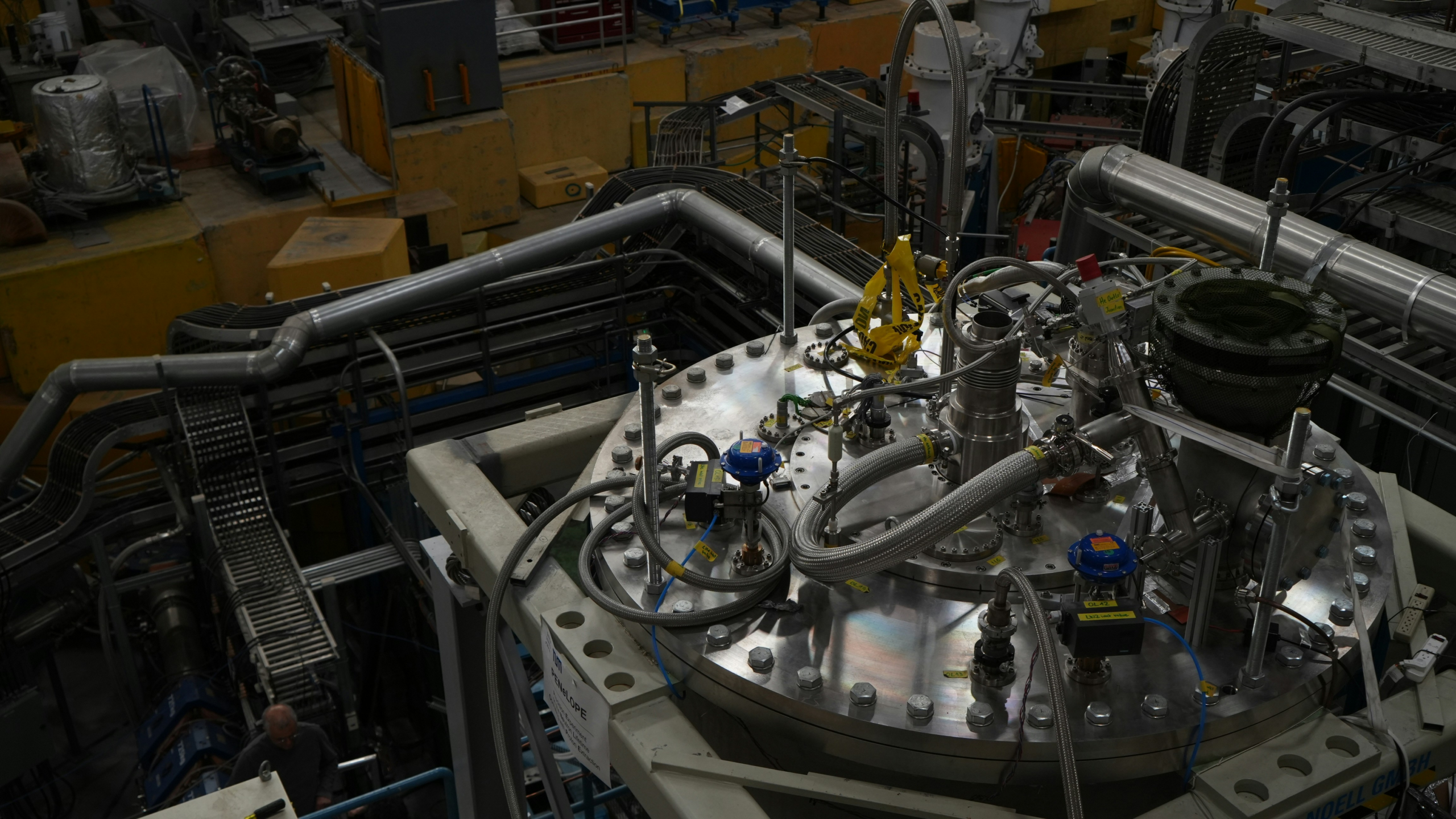
Idaho National Laboratory (INL) is testing new varieties of TRISO fuel in its Advanced Test Reactor (ATR). The American Nuclear Society’s Nuclear Newswire reported on September 18, 2026 that three companies have experiments in the program: X-energy, BWX Technologies (BWXT) and Radiant. The tests are early. Nothing in them licenses a fuel or a reactor.
What is going into the reactor
TRISO fuel particles are smaller than a poppy seed. Each has a fuel kernel inside carbon and ceramic layers meant to hold fission products in. INL says TRISO can withstand temperatures above 1,600 degrees Celsius, the worst-case accident temperature for some high-temperature gas-cooled reactor designs. That is a lab-tested design property, not a guarantee against every accident.
INL runs the ATR, a 250 MW test reactor that ANS calls the gold standard for fuel testing. The companies supply the fuel samples.
| Company | Experiment | Status per ANS | Source |
|---|---|---|---|
| X-energy | XPeRT: near-full-size pebble for the Xe-100 (80 MWe / 200 MWt) | Being irradiated now; 16 test pebbles at 50 mm | ANS Nuclear Newswire |
| BWXT | Fuel forms for BANR (75 MWt); five uranium nitride and UCO variations | Preparing to irradiate | ANS Nuclear Newswire |
| Radiant | RAFT: HALEU TRISO from Standard Nuclear for Kaleidos (about 3 MWt) | Preparing; runs alongside the Kaleidos test at DOME | ANS Nuclear Newswire |
After irradiation, samples go to INL’s Materials and Fuels Complex. There they face accident-temperature heating of 1,600 to 1,800 degrees Celsius and oxidation tests in air or moisture. This kind of work builds on the Advanced Gas Reactor program, which began in 2002.
Works well, be careful
| Works well | Be careful |
|---|---|
| TRISO is designed to retain fission products above 1,600 degrees Celsius. | That is a lab-tested design property, not a guarantee against every accident. |
| X-energy’s experiment is already being irradiated. | BWXT and Radiant are still preparing, so their results are not available. |
| INL’s Stempien said uranium nitride (UN) kernels are 20 to 25 percent denser than uranium oxycarbide (UCO). Denser fuel could allow longer runs at the same power or a smaller core. | ANS notes UN is largely untested. The density figure describes the kernel material, not a measured gain in reactor life. |
| The tests show how fuel behaves under irradiation and heating. | They do not show that a reactor built on this fuel is licensed, cheap or free of accident risk. |
Taken together: good early evidence is possible, but only one of the three experiments is actually running. The UN density benefit is a hypothesis for now. We found no source giving a delivered power cost for any of these designs, so we make no claims about bills or prices, and reactors using this fuel would still need regulatory approval and a site.
Why It Matters to You
If you aren’t a reactor designer, you won’t see a benefit from this directly. The tests are meant to show whether three companies’ advanced reactor designs can rely on fuel that holds up at very high temperatures. Any payoff, such as safer or longer-running reactors, depends on results that don’t exist yet and on licensing that hasn’t happened. Rural electric cooperatives are the one group with a near-term path, through the USDA program below, though no co-op has announced a plan based on this fuel.
The USDA funding round for rural co-ops
Separately, ANS reported on September 18 that the US Department of Agriculture opened the Affordable Rural Cooperative Program (ARC), which offers $175 million in loans, grants or both. No single recipient can receive more than $20 million. Eligible uses include buying a share of a nuclear plant, upgrading a nuclear facility, or buying nuclear energy under a power purchase agreement. The article does not say how the $175 million splits between nuclear and transmission.
Letters of interest open October 19 and close November 20. Awards are expected in summer or fall 2027. Co-ops are eligible to apply.
Quick answers
Does TRISO make a reactor meltdown-proof?
No source we opened makes that claim. TRISO is designed to retain fission products at very high temperatures, which lowers some risks. Designers and regulators still analyze accident scenarios for each reactor.
What is HALEU?
High-assay low-enriched uranium, enriched between 5 and 20 percent uranium-235. Radiant’s RAFT experiment uses HALEU TRISO fuel from Standard Nuclear.
When will results be public?
ANS gives no results date. Irradiation and postirradiation examination typically take years, so expect findings well after the tests start.
Sources
- ANS Nuclear Newswire: Industry and INL collaborate to test new varieties of TRISO fuel (Sep 18, 2026)
- ANS Nuclear Newswire: USDA opens nuclear power funding opportunity for rural electric cooperatives (Sep 18, 2026)
- World Nuclear News: TRISO fuel delivered for Kaleidos reactor experiment (Jul 3, 2026)